Address
No. 3F07, Tao Cube, No.68, CCIH, Jihua West Road,Chancheng District, Foshan City, Guangdong, China.

what is the largest tile format? | Contigo Ceramics

What Is the Largest Tile Format Available Today?
The largest tile format commonly produced in the ceramic and porcelain tile industry is a slab measuring 1600×3200 mm (63×126 inches). Some factories have achieved sizes up to 1800×3600 mm (71×142 inches) and even beyond using specialized roller kilns. At Contigo Ceramics, our Foshan, China facility runs 3600-7800T hydraulic presses combined with 1200-1250°C roller kilns to produce large-format tiles up to 1200×2400 mm as standard, with custom slab sizes available on order. These formats are classified as “large-format tiles” (LFT) according to ISO 10545 and ANSI A137.1 standards. The defining characteristic is that no side is smaller than 600 mm, and the ratio between sides is typically 2:1 or greater. Understanding what is the largest tile format matters because it affects logistics, subfloor preparation, cutting methods, and installation crew training.
Key Takeaways
- The largest tile format commonly available is 1600×3200 mm; Contigo Ceramics produces up to 1200×2400 mm standard.
- Installation of large-format tiles requires specific tools: a 36-inch wet saw, levelling clips, and a minimum 1/2″ trowel notch size.
- ANSI A137.1 sets tolerances for warpage — large slabs require 95% flat subfloors to avoid lippage.
- Using large format tile on a shower floor is possible with envelope cut technique; we cover the step-by-step below.
- Stone-look large format tiles are a budget-friendly alternative to natural stone for backsplashes and accent walls.
- Contigo Ceramics offers factory-direct pricing with MOQ flexibility for both containers and partial pallets.
How Are Large Format Tiles Defined By Industry Standards?
ISO 10545 (Part 2) classifies tiles by size, but does not explicitly define “large format.” The North American TCNA (Tile Council of North America) and ANSI A137.1 define large-format tile as any tile with at least one side length ≥ 609.6 mm (24 inches). The Porcelain Enamel Institute (PEI) rating for wear resistance is the same for any size — large format does not change abrasion class. At our factory, we test every batch for dimensions per ISO 10545-2: length, width, thickness, straightness of sides, and surface flatness. For example, a 1200×2400 mm tile must have a length deviation of no more than ±0.6% and a thickness tolerance of ±0.5 mm. These specs ensure the largest tile format you buy from Contigo Ceramics will lock together without lippage when installed correctly.
What Is the Largest Tile Format for Residential Floors?
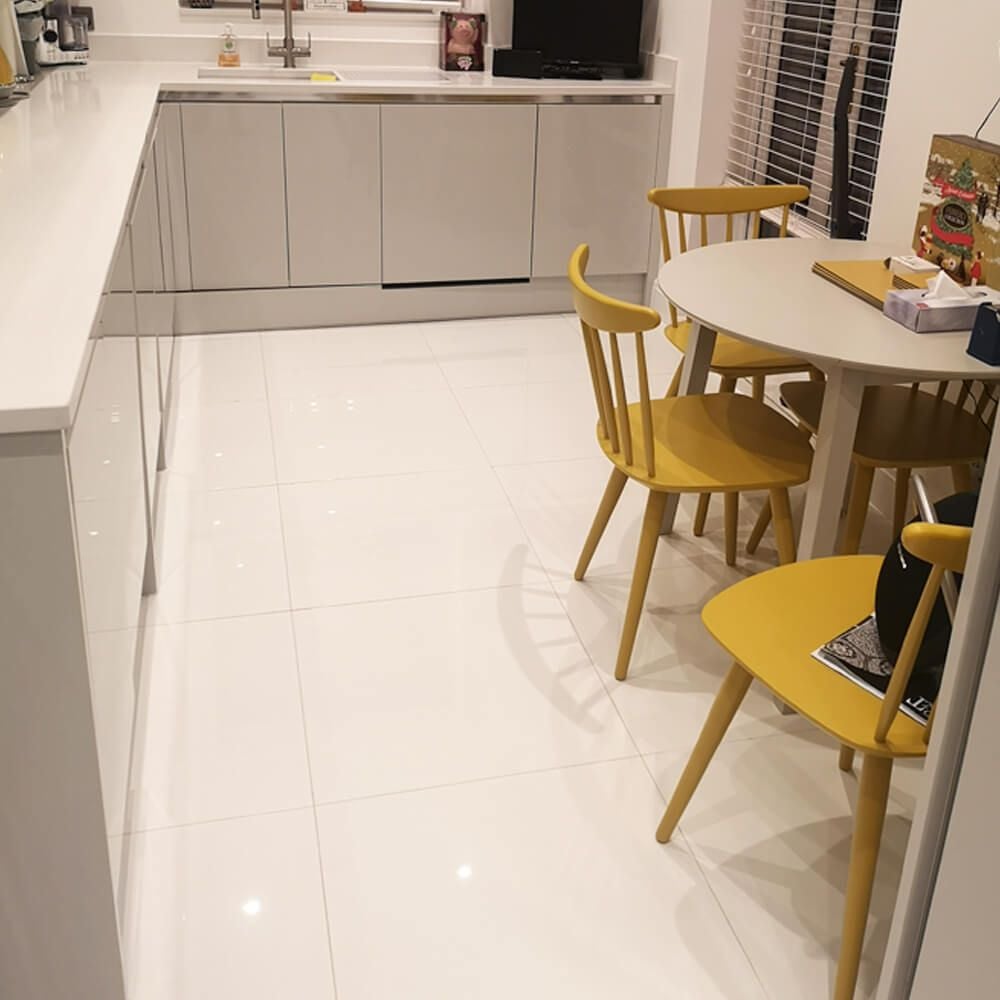
For residential floors, the most common largest tile format is 1200×600 mm (24×48 inches) and 1600×800 mm (63×31 inches). Slabs up to 1800×900 mm are available but require reinforced subfloors and a minimum of two installers. The floor must be dead flat — ANSI A108.02 requires the substrate to be flat to within 1/4 inch in 10 feet (6 mm in 3 m) for tiles with one side > 610 mm. If your subfloor exceeds that tolerance, you risk lippage and cracked tiles. At Contigo Ceramics, we recommend a 1/2″ x 1/2″ square-notched trowel and medium-bed mortar (not thin-set) for tiles larger than 600 mm per side. Contact us for a factory audit of your slab requirements: we can produce custom sizes down to 200×200 mm with the same digital inkjet printing technology used on our largest formats.
Can You Install Large Format Tile on a Shower Floor?
Yes, but it requires the envelope cut technique. Many competitors skip this topic — it’s a common search gap. Using large format tile on a shower floor is challenging because the floor must slope toward the drain (typically 1/4″ per foot). Standard small mosaics easily follow curves; a 1200×2400 mm slab cannot bend. The envelope cut method involves cutting the tile into four or more pieces with diagonal cuts radiating from the centre drain, then setting each piece so the edges slope downward. Each piece must be cut precisely with a wet saw using a continuous rim diamond blade. At our Foshan factory, we pre-cut and dry-lay these patterns before shipment for large shower projects — ask us about custom fabrication. Always use a waterproof membrane and DCOF ≥ 0.42 slip-resistance porcelain. Our outdoor tile collection meets DCOF 0.6+ for extra safety.
Envelope Cut Tutorial (Step-by-Step)
- Place the drain cover at the centre of the shower floor.
- Mark a cross on the tile aligning with the drain centre.
- Cut the tile into four quarters along the marked lines.
- Dry-lay each quarter, marking where the edge meets the drain flange.
- Cut a 45° angle on the inner corner of each quarter to fit around the drain.
- Set each quarter with the outer edge resting on mortar, inner edge raised by 6 mm.
- Use a 4-foot level to check uniform slope into the drain.
This installation method works best with rectified (mechanically calibrated) tiles. Contigo Ceramics rectifies all large-format tiles with a mechanical line that ensures all edges are precisely 90° to within 0.2 mm. This eliminates the “see-saw” effect common when using large tiles on sloped substrates.
Large Format Tiles That Look Like Real Stone: DIY Budget Backsplash
One of the fastest-growing applications for the largest tile format is the stone-look porcelain tile used as a budget backsplash. Natural marble or limestone slabs cost $50–$150 per square foot plus 90-day lead times. Porcelain tiles that mimic stone using digital inkjet printing cost $2–$8 per square foot from Contigo Ceramics — factory direct, no middleman markup. Our 1200×600 mm stone-look tiles use a 7-colour inkjet system with high-definition (720 dpi) texture overlays. The surface can be polished, matt, or structured (glazed). For a DIY backsplash installation, we recommend matte finish (PEI 4 or 5) with mechanical rectification so the grout joint is as narrow as 1.5 mm. No sealing required, unlike real stone. Cut the tiles with a 7-inch wet saw — score-and-snap tools do not work reliably on large-format porcelain.
Budget DIY Installation Tips
- Use a laser level to mark the first row — large tiles magnify any error.
- Back-butter every tile: spread a 1/4″ notch trowel on the wall, then a skim coat on the tile back.
- Leave a 3 mm expansion gap at the countertop and cabinets — fill with silicone.
- Apply grout the same day: large tiles have large surface area, and dried mortar on face is hard to remove later.
- If using a stone-look pattern, vary the orientation to avoid repeat lines — our inkjet system supports non-repeating patterns up to 6 tiles.
What Are the Challenges of Handling the Largest Tile Format?
From factory to final floor, the largest tile format presents five main challenges:
| Challenge | Why It Matters | Contigo Ceramics Solution |
|---|---|---|
| Transportation | Slabs over 63″ may not fit standard elevators or truck beds. | We offer split shipments (2 tiles per pallet) and custom crate sizes. |
| Subfloor flatness | ANSI requires 1/4″ in 10′ — most residential floors exceed that. | Provide self-levelling compound spec sheet; we supply recommended mortar. |
| Cutting equipment | Portable snap cutters max out at 24″ width. | We recommend 36″ continuous rim wet saw or 4′ bridge saw — available for rent in most markets. |
| Lippage | Even 1 mm height difference is visible on large reflections. | Mechanical rectification ensures ±0.2 mm edge tolerance; include levelling clips in every order. |
| Installation crew | 1 installer cannot safely lift a 1200×2400 mm tile alone. | Minimum 2-person crew required; we provide handle suction cups on request. |
At our Foshan, China facility, we train our quality control team to simulate installation conditions during inspection. We apply a 45° lifting test and check the tile’s weight distribution — a 1200×2400 mm porcelain tile weighs approximately 45-55 kg (99-121 lb) depending on thickness (8-12 mm). We mark the weight on each box so installers can plan handling.
How to Choose the Right Large Format Tile for Your Project
Three factors determine whether a particular tile format is right for you: subfloor condition, access constraints, and aesthetic intent. If your subfloor slopes more than 1/4″ in 10 feet, choose a smaller format (e.g., 600×600 mm) to reduce lippage risk. If you need to carry tiles up multiple staircases or into an attic, measure door widths and elevator dimensions first — a 3200 mm long slab will not fit in a standard residential lift. For a continuous stone-like appearance, the largest possible format reduces grout lines and creates visual flow. Contigo Ceramics stocks approximately 30 colours in 1200×600 mm format plus 15 in 1600×800 mm – all using the same digital inkjet technology for colour consistency across sizes. We can produce custom 1800×900 mm slabs for commercial projects with a minimum order of 300 square metres.
Frequently Asked Questions
What is the largest tile format commonly used in commercial kitchens?
Commercial kitchens typically use 600×600 mm or 1200×600 mm large-format porcelain tiles. The 600×600 mm is preferred because it meets NSF/ANSI 51 for food zones and is easier to replace if cracked. For walls, 1200×600 mm saves cleaning time due to fewer grout lines.
What is the largest tile format that can be installed on a wall without additional support?
Tiles up to 1200×600 mm can be installed on standard drywall or cement board using medium-bed mortar. Slabs larger than 1600×800 mm require mechanical anchors or a reinforced substrate to prevent shear failure. We always recommend testing adhesion on a small area before full installation.
Does the largest tile format require special grout?
Yes. Use a polymer-modified unsanded grout for joints under 3 mm (typical with rectified tiles) and sanded grout for joints 3-6 mm. Epoxy grout is recommended for outdoor or wet areas. Standard cementitious grout may shrink and crack when used with large-format tiles due to thermal movement.
How does Contigo Ceramics ensure the largest tile format meets ANSI A137.1 flatness standards?
Every production batch undergoes mechanical rectification after firing. We use a 16-24 head polishing and rectification line that calibrates all four edges to within 0.2 mm tolerance. Additionally, a laser flatness check compares the surface to a reference plane — tiles exceeding 0.75% warpage are rejected and ground down.
What MOQ applies for custom large-format tile sizes?
For standard sizes like 1200×600 mm and 1600×800 mm, we accept orders from 50 square metres (partial pallets). Custom sizes (e.g., 1800×900 mm or 3200×1600 mm) require a minimum of 300 square metres per colour. We can ship less-than-container-load (LCL) for smaller projects — ask our sales team for a quote via /contact-us/.
Conclusion
Understanding what is the largest tile format helps you avoid costly mistakes in flooring, wall cladding, and shower installations. The current practical maximum is 1600×3200 mm, but for most residential projects, 1200×600 mm or 1600×800 mm offers the best balance of visual impact, logistics, and installation labour. At Contigo Ceramics, we produce large-format tiles using ISO 10545-tested processes, mechanical rectification, and digital inkjet printing — all from our factory in Foshan, China. We ship directly to importers and contractors worldwide, with no middleman markups. Visit our /large-format-guide/ for detailed technical comparisons, or contact us via /contact-us/ to request a quote and factory audit. Written by the Contigo Ceramics technical team, Foshan, China.