Address
No. 3F07, Tao Cube, No.68, CCIH, Jihua West Road,Chancheng District, Foshan City, Guangdong, China.

How to Prepare for Tile Shade Variation


How Do You Handle Tile Shade Variation?
Do you handle tile shade variation proactively? If you don’t, I urge you to start. Not only is it a great opportunity to educate your customers about tile installation methods, standards and best practices, but it also helps you avoid what I refer to as the “Five‑O‑Five Surprise.” Understanding tile shade variation is essential for every installer and salesperson.
What Is the Five‑O‑Five Surprise?
Almost every residential installer has heard the phrase uttered from a surprised customer at five minutes after five o’clock in the afternoon, after the tile has been installed:
“That is not the tile that I picked!”
or
“My newly tiled floor doesn’t look anything like the sample board.”
This gut‑wrenching feeling may occur when the client is not fully aware of shade variation that can occur with ceramic and porcelain tiles. Hopefully, it wasn’t your customer and you gained this valuable lesson from someone else’s mistake or oversight, but it could happen to you if you are not careful.
Five Recommendations for Handling Tile Shade Variation
As I mentioned, shade variation can occur with ceramic and porcelain tiles. It can also happen as a result of new tile trends where designs purposely exhibit substantial variation in pattern from tile to tile.
Here are five recommendations to prevent the “Five‑O‑Five” surprise and ensure customer satisfaction.
1. Educate Customers About Shade Variation
Inform consumers that the tile they receive most likely will not look exactly like the piece on the sample board. This variation in shade—some very subtle and some widely varied—is normal and expected. Set realistic expectations early in the sales process.
2. Use a Tile Shade Variation Chart
visuals speak louder than words. Look for a tile shade variation chart and refer to it with customers. Most sample boards or tile literature now list a range of shade, tone, texture and color as found in the TCNA Handbook and similarly in the ANSI A137.1 Specifications for Ceramic Tile.
The chart ranges from V0 (zero) which exhibits no shade range detectable by the average eye to the potentially extremely varied color and tone of a V4. You’ll find more detail in the section below titled “Tile Shade Variation Categories.”
3. Be Cautious of Online Tile Selections
Be especially cautious of consumers who make tile selections from a single color photo or image online. While convenient, there’s no substitute for seeing, touching, and experiencing the actual tile before ordering. Additionally, a computer or tablet monitor may not display colors accurately. There’s often no recourse once you’ve installed the tile, except to remove it and start over—a costly mistake.
4. Show Multiple Tile Pieces
Compounding the 5:05 surprise is when consumers select tile without the assistance of a knowledgeable installer or salesperson. This is particularly true if they select tile based on a single piece or from a small cut piece on a sample board. One single piece cannot adequately represent the overall effect of a full installation.
Instead, have several tile pieces available to demonstrate shade variation, especially if the tile falls in the V2 to V4 range (see below). This simple step can prevent misunderstandings and unhappy customers.
5. Insist on a Mockup
The safest way to eliminate the “Five‑O‑Five” surprise is to provide your customer with a mounted and grouted panel that shows the tile shade, pattern layout (if applicable), and the size and color of the grout joint before the job begins.
When this mockup is approved, the customer should sign and date the back. This offers proof that the entire spectrum of the tile job has their approval and protects you from liability.
> See Why a Tile Installation Mockup Is Really Necessary (internal link – replace with actual URL)
You may say that following this procedure costs additional time and money—which it does—but this cost is minimal compared to the expense of a tear‑out and replacement. I assure you that fulfilling your customers’ tile desires in advance saves a lot of headaches and money.
Tile Shade Variation Categories: V0 to V4
Here is the chart I referred to above, along with detail on each of the variation categories.
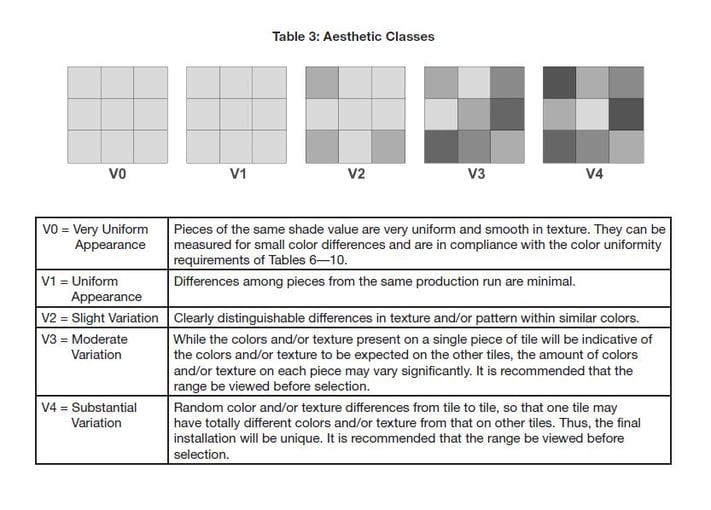
V0 = Very Uniform Appearance
Pieces of the same shade value are very uniform and smooth in texture. They can be measured for small color differences and are in compliance with color uniformity requirements.
V1 = Uniform Appearance
Differences among pieces from the same production run are minimal.
V2 = Slight Variation
You’ll notice clearly distinguishable differences in texture and/or pattern within similar colors.
V3 = Moderate Variation
While the colors and/or texture present on a single tile will be indicative of the colors and/or texture to be expected on the other tiles, the amount of colors and/or texture on each piece may vary significantly. It’s recommended that the range be viewed before selection.
V4 = Substantial Variation
Random color and/or texture differ from tile to tile, so that one tile may have totally different colors and/or texture from that on other tiles. Thus, the final installation will be unique. It’s recommended that the range be viewed before selection.
For more guidance on tile selection, visit our Tile Buying Guide or contact our team for personalized assistance.