Address
No. 3F07, Tao Cube, No.68, CCIH, Jihua West Road,Chancheng District, Foshan City, Guangdong, China.

How to Verify a Kitchen Countertop Slab Supplier in China — Audit Checklist for Netherlands Importers

Why Verifying a Chinese Kitchen Countertop Slab Supplier Matters
For Netherlands importers, buying kitchen countertop slabs sight-unseen from China carries real financial and logistical risks. A porcelain slab factory that looks professional on Alibaba may be a trading company operating from a repurposed warehouse — or worse, a middleman sending you substandard material that fails to meet European CE standards.
Since 1999, we at Contigo Ceramics (Foshan, Guangdong) have witnessed dozens of Dutch buyers lose deposits or receive slabs with dimensional tolerance errors exceeding 1 mm, color variation across batches, or low MOR (Modulus of Rupture) values that crack during installation. A thorough factory audit — including a live video tour, certification verification, and third-party inspection — is your only safeguard. This guide provides a concrete checklist for Netherlands importers to vet suppliers before committing to a 20ft container order (our MOQ).
Factory Audit Checklist Table — 10 Critical Items
Use this table when evaluating any Chinese slab supplier. Each item must be verified, not just claimed.
| # | Audit Item | What to Request | How to Verify |
|---|---|---|---|
| 1 | Business License | Scanned copy with unified social credit code | Search on China’s National Enterprise Credit System (free) |
| 2 | Export License & Customs Registration | Foreign Trade Operator filing number | Confirm with China customs database or ask for recent Bill of Lading |
| 3 | Factory Ownership Proof | Real estate certificate or lease agreement with property owner stamp | Video call showing factory exterior and street address sign |
| 4 | Production Equipment List | Brand, model, capacity of kilns (e.g., SACMI, System) and presses (e.g., SITI, Laminam) | Match claimed specs with video footage during live tour |
| 5 | ISO 10545 & CE Certification | Scanned certificate with certification body logo | Verify on the certifier’s website (e.g., TÜV SÜD, TÜV Rheinland). Never rely on copy alone. |
| 6 | Reference Clients in Europe | At least 3 B2B buyes with contact details (distributors, not resellers) | Call or email them directly. Ask about delivery times, defect rate, after-sales support. |
| 7 | Sample Quality Report | Test report for water absorption ≤0.5%, MOR ≥35 MPa, PEI rating ≥4 | Cross-check with ISO 10545 methods. Demand samples shipped to Netherlands for your own lab test. |
| 8 | Warehouse Stock Photos with Date Stamp | Clear images of current inventory showing color, size, and quantity | Schedule a live video walkthrough of the warehouse area (see section 3). |
| 9 | Compliance with CE Marking (EU 305/2011) | DoP (Declaration of Performance) document | Verify DoP number on the Notified Body database (e.g., NB 1234). |
| 10 | Third-Party Inspection Willingness | Written agreement to allow SGS, Bureau Veritas, or TÜV inspection before shipment | Check if supplier covers inspection cost or splits fee. Refusal is a major red flag. |
Pro tip from 20+ years experience: Many suppliers will offer you a “factory certificate” issued by a local Chinese body. Always insist on international certification from an accredited third party — we carry ISO 10545 and TCNA/ANSI A137.1 (porcelain tile standards) for our full range.
How to Do a Video Factory Tour via WeChat — What to Look For
A WeChat video call (WeChat is essential for communication with Chinese factories) can reveal more than any sales pitch. Here’s a step-by-step checklist for your virtual walkthrough:
1. Production Noise Level
Ask the agent to walk past the production line. You should hear the continuous hum of a running kiln (1100–1300°C), the sound of hydraulic presses (3000–5000 tons), and grinding machines. Silence means a rented studio, not a working factory.
2. Kiln Panel Display
Request a close-up of the digital temperature control panel. It should show current firing temperature and speed. A reputable factory like Contigo Ceramics operates 24/7 and will share real-time data.
3. Warehouse Stock with Batch Numbers
Have the camera pan across pallets. Look for batch numbers, production dates, and consistent color tones. If the stock is neatly stacked with clear labels, it signals professional inventory management. Avoid suppliers showing only a few sample boards on a display wall.
4. Loading Bay and Forklift Activity
An active loading bay with containers being packed indicates real turnover. Ask to see the export packaging line where slabs are crated for FOB shipment at Huangpu Port (about 40 km from Foshan).
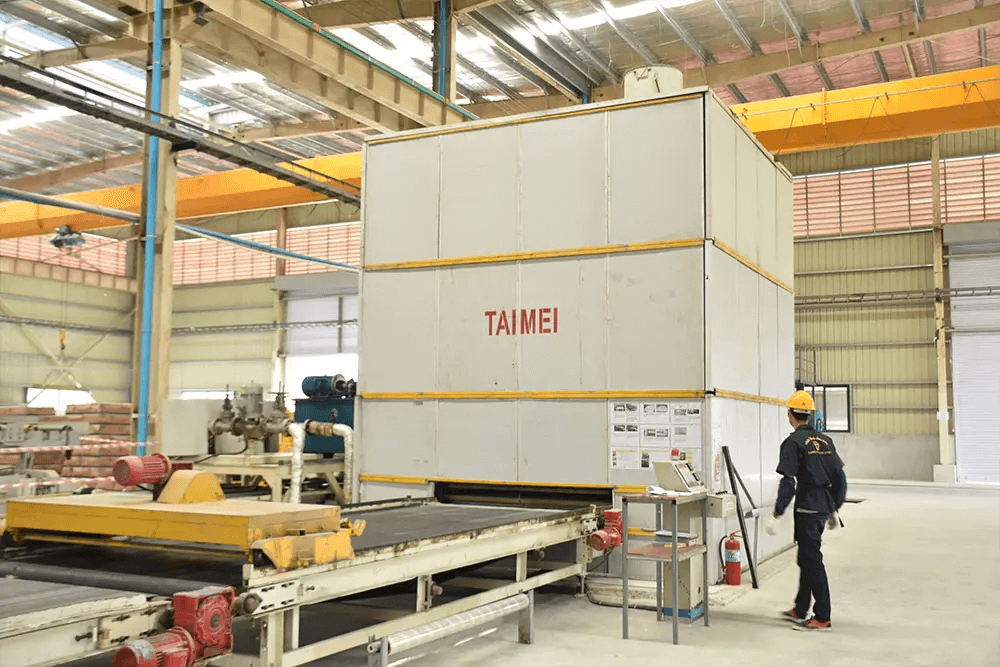
Our team at Contigo Ceramics is happy to schedule a live WeChat video tour — simply contact us to arrange a time that fits your Netherlands time zone (UTC+1).
Certification Guide: ISO 10545, CE Marking, and Country‑Specific Labels
Netherlands importers must comply with EU Construction Products Regulation (CPR 305/2011). Below is how to verify the most critical certifications for kitchen countertop slabs:
ISO 10545 – The Universal Porcelain Standard
This standard covers 16 test methods, including water absorption, modulus of rupture, and chemical resistance. Request the original test report from the factory lab or a third-party lab. Cross-check the report number with the issuing body (e.g., ISO 10545-4 for modulus of rupture). Beware of certificates that reference “ISO 9001” only — that’s for quality management, not product specifications.
CE Marking with DoP
For EU countries, the supplier must provide a Declaration of Performance (DoP) that lists the slab’s reaction to fire, water absorption, and thermal conductivity. The DoP number must be traceable to a notified body (e.g., NB 1234). Never accept a DoP without a notified body number — we at Contigo Ceramics issue DoPs through TÜV Rheinland for all our large-format porcelain slabs.
Additional Certifications: ANSI A137.1 & TCNA
While not mandatory in Europe, ANSI A137.1 (often used in North America) indicates high durability. We also comply with TCNA standards for dimensional tolerances (±0.5 mm on length). Ask your supplier if they can provide a TCNA test report — it’s a strong indicator of quality control.
Third-Party Inspection: SGS, Bureau Veritas, TÜV — Cost, Process, and What They Check
Never ship a container without an independent inspection, especially for first-time orders. The three most reliable firms are SGS, Bureau Veritas, and TÜV. Here’s what you can expect:
Cost
- Inspection of one 20ft container (approx. 1,000 m² of slabs): USD 500–800 depending on the city (Foshan is cheaper than Shanghai).
- The fee is usually split between buyer and seller — a serious factory will agree to cover 50%.
Process
- You book the inspection through the agency’s website (e.g., SGS China).
- An inspector visits the factory at an agreed date (usually during production or before loading).
- They randomly select 5–10% of the container quantity and perform checks: visual defects (cracks, chips, color variation), dimensional accuracy (length/width/thickness using calibrated callipers), and water absorption test (ASTM C373 or ISO 10545-3).
- You receive a report within 2–3 business days with a pass/fail recommendation.
What They Check
- Visual inspection: Surface imperfections, edge chipping, rectification quality.
- Dimensional tolerance: Length and width within ±0.5 mm, thickness within ±0.2 mm.
- Water absorption: <0.5% confirms full vitrification (true porcelain).
- Modulus of rupture: Minimum 35 MPa for countertop use (our slabs exceed 45 MPa).
At Contigo Ceramics, we welcome third-party inspections and have a dedicated QC area for random sampling. Contact us to coordinate an inspection timeline.
Red Flags: 5 Warning Signs of a Trading Company Posing as a Factory
Many ”factories” in Foshan are actually trading companies renting a showroom. Here are unmistakable red flags:
- Refusal of Video Tour: “Our kiln is undergoing maintenance” or “We have a confidentiality policy.” Real factories are proud to show their production lines.
- Generic Certificates: ISO 9001 only, or certificates that have no logo/scanner of a recognized body. Counterfeit certificates are rampant.
- Inconsistent Address: The business license shows a residential building or a shared office tower. Demand a clear photo of the factory gate with the street name.
- No Stock for Sample Sending: If they cannot ship a full-sized sample slab (e.g., 1200x1200mm) within 48 hours, they likely don’t own inventory.
- Payment Terms That Avoid LC: Trading companies often demand 100% T/T upfront. Factories that have exported for years accept 30% deposit, 70% against copy of BL, or LC at sight.
We offer full factory direct pricing — no middlemen — and can prove our ownership of the production facility in glazed and polished porcelain lines.
FAQ — Supplier Verification for Netherlands Importers
Q1: Can I visit your factory in person?
Yes, we welcome visits. Our factory is in Foshan, 1 hour from Guangzhou Baiyun Airport. However, many Netherlands buyers prefer a video tour first. We recommend investing in a third-party inspection (SGS, Bureau Veritas) for the first order. Contact us to arrange either option.
Q2: How do I verify that your ISO certificate is not fake?
Ask for the certificate number and the issuing body (e.g., TÜV Rheinland ID 123456). Then search that body’s online verification portal. Our ISO 10545 is issued by TÜV Rheinland and can be verified on their website.
Q3: What is the minimum order quantity for countertop slabs?
Our MOQ is one 20ft container (approx. 1,000 m² of 6mm or 12mm porcelain slabs). For larger sizes (3200x1600mm), the MOQ is also one container. We ship FOB Huangpu Port or Foshan New Port.
Q4: What if the inspection finds defects?
If defects exceed the AQL (Acceptable Quality Limit) of 2.5% as per ISO 2859, we will sort or reprocess the batch at no cost. Our past export defect rate to Europe is below 0.5%.
Take Action: Verify Your Supplier Today
Don’t risk your next project on a supplier you’ve never seen. Whether you need a live WeChat tour, certified test reports, or an independent third-party inspection, Contigo Ceramics is ready to prove our quality.
We supply polished porcelain slabs, large-format panels, and outdoor-grade porcelain — all manufactured in our own kilns in Foshan, Guangdong since 1999.