Address
No. 3F07, Tao Cube, No.68, CCIH, Jihua West Road,Chancheng District, Foshan City, Guangdong, China.

china tiles price | Contigo Ceramics

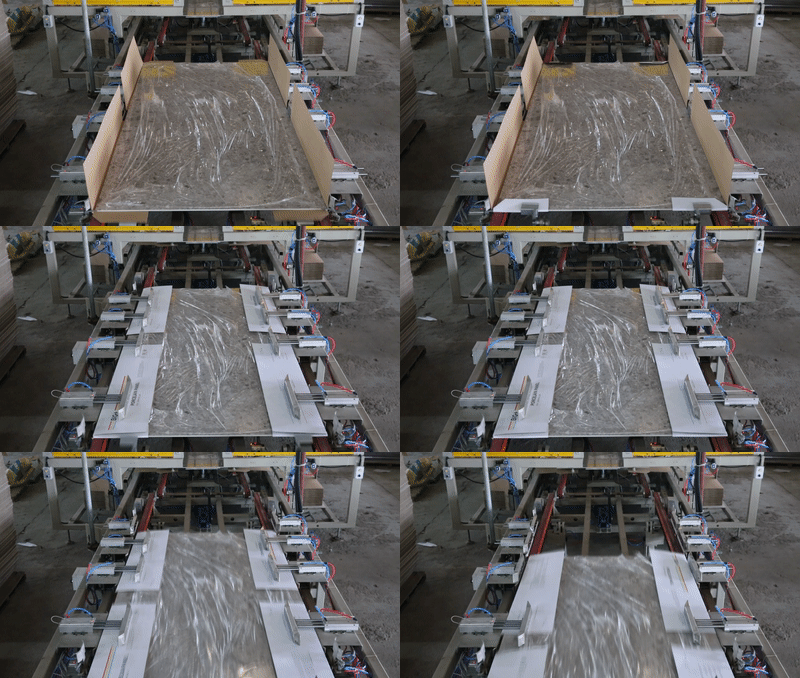
Understanding the china tiles price structure is the first step to making a smart bulk purchase. For international buyers, the difference between a $2 tile and a $5 tile often comes down to specific manufacturing choices, not just profit margins. At Contigo Ceramics, our Foshan, China facility produces directly for global buyers. This means we know exactly where every dollar goes. Price transparency starts with production knowledge.
Key Takeaways
- China tiles price is determined by body type, size, and finish—not factory location alone.
- Rectified edges and digital inkjet printing improve installation results but increase manufacturing costs.
- ISO 10545 and ANSI A137.1 certifications verify if a tile matches its stated price.
- Direct factory sourcing from Foshan removes 2-3 intermediary markups from the final price.
- MOQ affects unit price; understanding breakpoints saves 10-15% on total order cost.
What Does “China Tiles Price” Actually Mean in 2025?
China tiles price refers to the ex-works cost of ceramic and porcelain tiles manufactured in China, primarily in the Foshan district, before international shipping, tariffs, and distributor markups are applied. This price is determined by measurable factors: the core raw material composition (clay, feldspar, kaolin), the firing temperature (1200-1250°C for full vitrification), the pressing pressure (3600-7800T), surface treatment (digital glaze, inkjet depth), size rectification, and finish polishing. Unlike retail prices which include brand premiums and nationwide distribution networks, the factory-direct china tiles price reflects actual production cost plus a manufacturing margin. For professional specifiers, understanding this breakdown enables direct comparison between suppliers on equal footing. Contigo Ceramics, based in Foshan, operates its own roller kiln and polishing line, allowing us to offer transparent pricing tied directly to these engineering specifications.
How Is the Price of Chinese Ceramic Tiles Calculated?
Most buyers assume the price is random. It is not. Every dollar is tied to a measurable manufacturing input. At our Foshan facility, we break down costs into three distinct layers.
Raw Material Costs: The Base Layer
The clay, silica, feldspar, and kaolin body determines the starting cost. Fully vitrified porcelain requires higher-grade raw materials than porous ceramic. China tiles price for porcelain starts higher because the raw body must withstand 1250°C firing without warping.
Manufacturing Complexity: Size, Body, and Finish
Larger formats require higher tonnage presses. A 1200x2400mm tile needs a 7800T press. The same tile in 600x600mm runs on a 3600T press. Equipment wear, energy consumption, and rejection rates all increase with size. This directly affects the china tiles price per square meter.
Surface Treatment: Glaze vs. Digital Inkjet
Traditional glazing applies a uniform layer. Digital inkjet printing applies specific micro-droplets of ink and glaze. It offers better pattern resolution and surface texture control. It also costs more per square meter due to machine investment and ink costs.
According to the Tile Council of North America (TCNA), proper vitrification is the single biggest factor in long-term tile performance. A tile that fires correctly at 1250°C will outlast a cheaper equivalent by years. Source: TCNA Tile.
Factor 1: Body Type and Firing Temperature
The body type is the primary cost driver. A fully vitrified porcelain body fired above 1200°C is denser and more durable than a ceramic body fired at 1100°C. The difference is measurable in water absorption.
| Body Type | Firing Temp | Water Absorption | Relative Price Index | Best Use Case |
|---|---|---|---|---|
| Full Porcelain (Glazed) | 1250°C | <0.5% | 1.0x (baseline) | High-traffic commercial |
| Ceramic (Earthenware) | 1100°C | 3-7% | 0.6x | Residential walls |
| Double-Charged | 1250°C | <0.3% | 1.4x | Heavy industrial |
| Full Body Porcelain | 1250°C | <0.1% | 1.5x | High-traffic, no glaze needed |
If a china tiles price seems too low for heavy commercial use, check the body type. If it is ceramic (3-7% absorption), it will fail in high-moisture or high-load environments.
Factor 2: Size, Thickness, and Rectification
Size is a major cost variable. A 600x600mm porcelain tile requires 3600T pressing pressure. A 1200x2400mm tile needs 7800T pressure. The machinery cost, die wear, and rejection rate all scale with size. That is why large format tiles cost more per square meter than small format tiles from the same factory.
Rectification adds another layer. Mechanical rectification cuts every tile to exact dimensions, usually within +/-0.5mm. This ensures tight grout lines (1.5mm). Non-rectified tiles have wider tolerances and require larger grout joints. Rectification adds $0.20-$0.50 per square meter to the china tiles price. It saves money on installation labor and future maintenance. You can read more about sizing in our Large Format Technical Guide.
Factor 3: Surface Finish and Slip Resistance
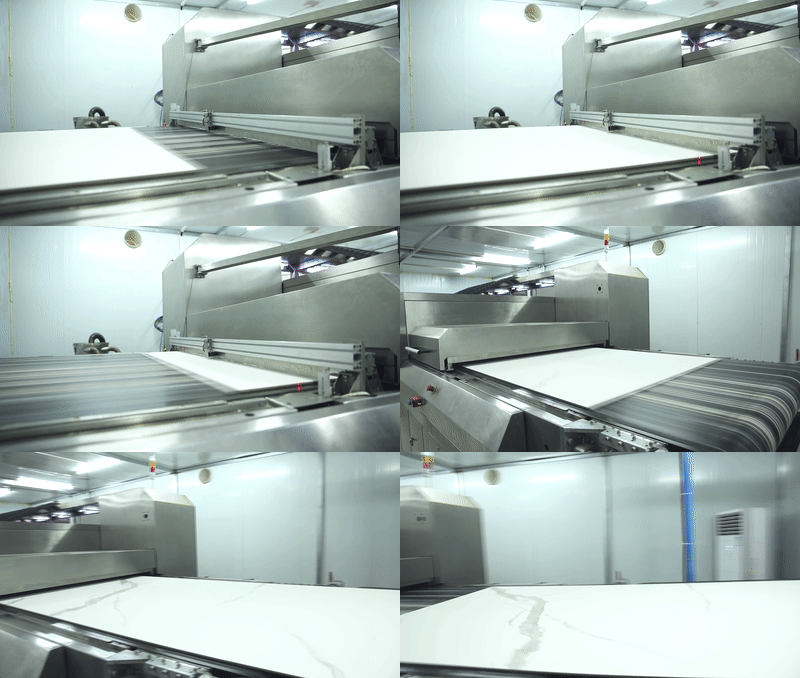
The surface finish changes the price. Polished tiles go through 16-24 polishing heads. Each head uses progressive grits to achieve a 60+ gloss unit finish. Matte tiles skip most of this process but require different glaze chemistry. Satin finishes sit in between.
DCOF (Dynamic Coefficient of Friction) also impacts cost. Tiles rated DCOF 0.42 or higher for commercial wet areas require specific surface textures. These textures often involve additional inkjet passes or specialized roller applications. At our Foshan facility, we adjust our glaze line specifically to meet ANSI A137.1 requirements for slip resistance. This adds cost but ensures safety compliance for international projects.
Factor 4: MOQ and Regional Logistics
Minimum order quantities directly affect unit price. A standard MOQ for a direct factory order from China is 500-1000 square meters per design. Smaller orders require repacking and logistical overhead, increasing the per-unit china tiles price.
- MOQ 500m²: Standard ex-works price applies.
- MOQ 100m²: +15-20% due to logistics and setup.
- MOQ 2000m²+: Volume discount of 5-10% is typical.
FOB (Free on Board) prices include loading at the port. CIF (Cost, Insurance, Freight) includes shipping and insurance. Always ask for FOB pricing directly from the factory to see the true china tiles price without shipping speculation. Our Complete Guide to Sourcing from China covers FOB vs CIF in detail.
How to Verify Quality Against China Tiles Price
Price alone is not quality. A cheap tile with 5% water absorption will fail outdoors. You need ISO 10545 certification to verify the standard. Without it, the china tiles price is just a number with no backing.
Water Absorption Standards
ISO 10545-3 tests water absorption. Porcelain must have less than 0.5% water absorption. Ceramic tiles range from 3% to 7%. Always request the test report. If the supplier cannot provide it, the china tiles price is too high regardless of the number.
PEI and Mohs Hardness
PEI (Porcelain Enamel Institute) rating measures glaze wear resistance. PEI 3 is suitable for residential floors. PEI 4-5 is needed for commercial spaces. Mohs hardness tests the glaze mineral hardness. A Mohs of 6-7 is standard for good porcelain. Ask your supplier for these ratings before comparing prices.
DCOF for Safety
For outdoor or commercial wet areas, DCOF must be measured. ANSI A137.1 requires a minimum of 0.42 for level interior wet areas. Our outdoor tiles at Contigo Ceramics Outdoor Collection are tested to exceed this threshold. If a supplier offers a low china tiles price for outdoor tiles but cannot provide DCOF data, proceed with caution.
Frequently Asked Questions
What is the current china tiles price for standard 600x600mm porcelain?
For full vitrified glazed porcelain, the ex-works price typically ranges from $4.50 to $6.50 per square meter depending on surface treatment and MOQ. Double-charged or polished finishes increase this range.
Why is china tiles price lower than European equivalents?
China benefits from vertically integrated raw material supply chains, lower energy costs, and direct labor in Foshan. European manufacturers often face higher regulatory and energy costs. The base technical quality, when produced to ISO 10545 standards, is comparable.
How can I verify if a china tiles price reflects good quality?
Request ISO 10545 test reports for water absorption, breaking strength, and stain resistance. Ask for DCOF data for floor tiles. Verify rectification tolerances. A price without these documents is not comparable.
What is the typical MOQ for direct factory china tiles price quotes?
Most Foshan factories require 500-1000 square meters per design for standard production. At Contigo Ceramics, we offer flexible MOQ options for repeat buyers. Check our Manufacturing Process Guide for production timelines.
Does shipping affect the per-unit china tiles price significantly?
Yes. Add 15-25% for ocean freight and insurance depending on destination port. This is why ex-works or FOB pricing is critical for apples-to-apples comparison. Shipping costs are separate from china tiles price.
Conclusion
China tiles price is a direct reflection of manufacturing integrity. Body composition, firing temperature, pressing pressure, rectification, and surface finish all contribute to the final number. A lower price without technical backing is not a bargain. A higher price without documentation is overpaying. At Contigo Ceramics, we offer transparent ex-works pricing backed by ISO 10545 testing and ANSI A137.1 compliance. Our Foshan facility produces directly for global buyers. No middlemen. No hidden margins. Contact us to audit our factory, review our test reports, and compare our china tiles price against your current supplier. We guarantee manufacturing transparency at every step.
Written by the Contigo Ceramics technical team, Foshan, China.