Address
No. 3F07, Tao Cube, No.68, CCIH, Jihua West Road,Chancheng District, Foshan City, Guangdong, China.

Importing Kitchen Countertop Slab to Australia — Regulations, Tariffs & Market Trends 2026

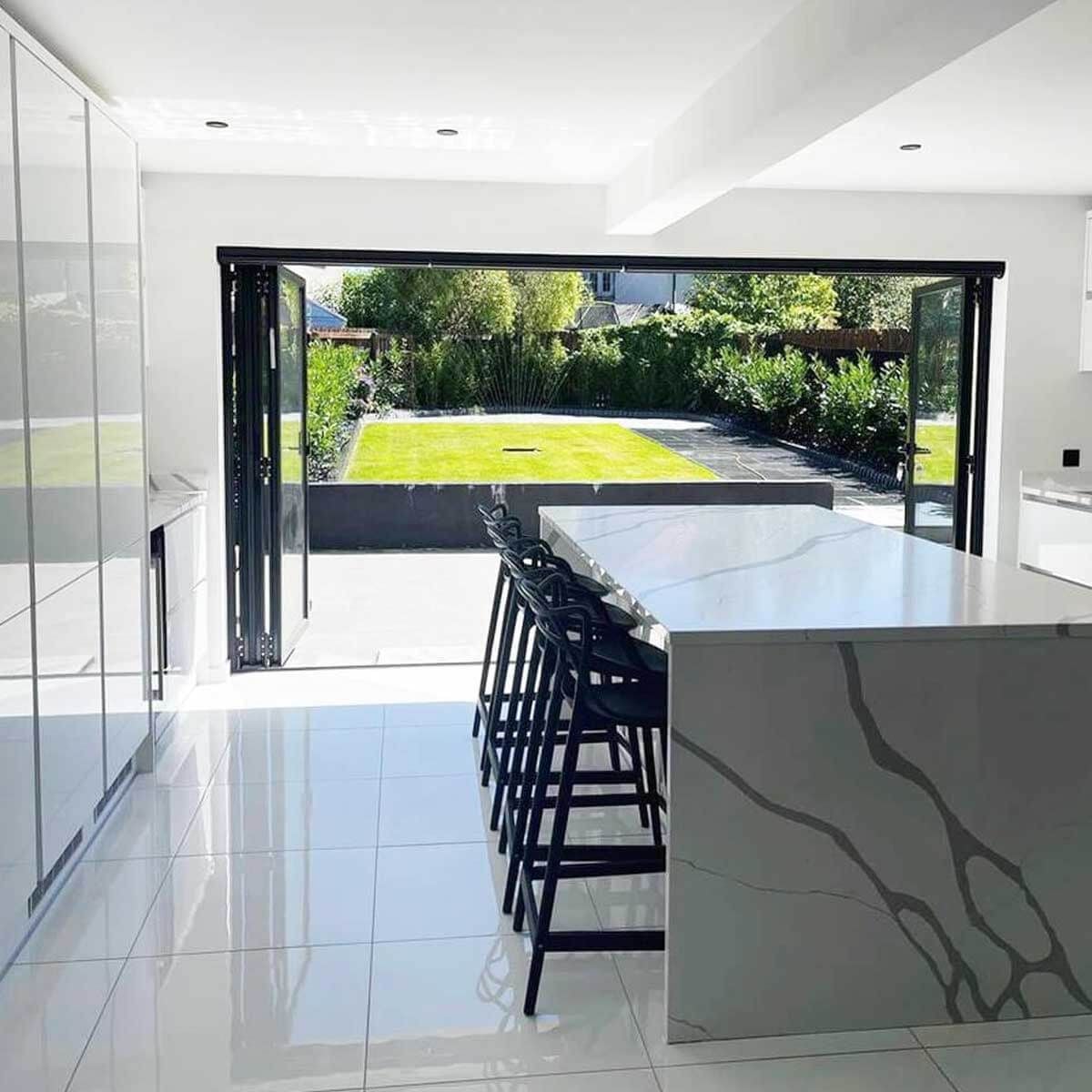
Australia’s Kitchen Countertop Slab Import Market: Size & Growth
Australia imported over 12 million square metres of ceramic and porcelain tiles in 2025 (IBISWorld), with large-format slabs exceeding 1200×2400 mm accounting for a rapidly growing share. The kitchen countertop segment alone is projected to grow 8–10% annually through 2026, driven by residential renovation, commercial fit-outs, and a shift from natural stone to engineered porcelain slabs. Key demand factors include durability, stain resistance, and zero maintenance. Importers who can offer kitchen countertop slab options in matte marble-look, concrete, and solid colours are capturing the highest margins. Australia relies heavily on imports—China supplies roughly 40% of ceramic tiles by volume—yet local distributors often add 30–50% markup. This creates a clear opportunity for direct factory sourcing.
Import Regulations Table — HS Codes, Duty Rates & Certifications
| HS Code (2022) | Product Description | General Duty Rate | ChAFTA Preferential Rate | GST | Key Certifications Accepted |
|---|---|---|---|---|---|
| 6907.40.00 | Finishing ceramic tiles (slabs for countertops, polished/glazed) | 5% | 0% (with Certificate of Origin) | 10% | ISO 10545 test reports, ANSI A137.1 compliant, Australian Standard AS 4459.1 |
| 6907.90.00 | Other ceramic tiles (unfinished, non-glazed, large-format) | 5% | 0% (with Certificate of Origin) | 10% | ISO 10545, slip resistance test (if wet area), flexural strength data |
Note on anti-dumping duties: Australia has applied anti-dumping measures on certain ceramic tiles from China (HS 6907.90 and 6907.40) since 2014. However, many large-format porcelain slabs used specifically for countertops are classified under HS 6907.40.00 with thickness ≥ 6mm and water absorption ≤ 0.5%—these are often exempt from anti-dumping if the exporter can demonstrate they are not “like goods” under the original investigation. Always verify with a customs broker before finalising your order. Contigo Ceramics provides full documentation to support duty exemption claims.
Key Tariff Advantages Under ChAFTA
The China–Australia Free Trade Agreement (ChAFTA) eliminates tariffs on most ceramic tiles when the importer provides a valid Certificate of Origin (COO) from Chinese customs. This reduces landed cost by 5%. Combined with the 10% GST (payable at border), net duty becomes zero. For a 40HQ container of slabs (approx. 1,200 m² at FOB $15/m²), that’s a saving of $900 AUD per container—enough to offer competitive pricing without sacrificing margin.
Certification Requirements Specific to Australia
Australia does not require SASO, CE, or SONCAP for ceramic tiles. Instead, importers must demonstrate compliance with:
- ISO 10545 (test methods) — water absorption, modulus of rupture, dimensional tolerance, stain resistance. Contigo Ceramics tests every production batch in its own laboratory and provides certified reports.
- ANSI A137.1 (product specifications) — while not mandatory, many Australian specifiers require porcelain slabs to meet ANSI A137.1 for commercial projects, especially for floor-to-countertop continuity.
- Australian Standard AS 4459.1 — voluntary but strongly recommended for slip resistance (P3 or P4) if the slab extends to a breakfast bar. For pure countertops, only water absorption ≤ 0.5% and breaking strength ≥ 1,300 N are relevant.
- Green Star / LEED documentation — increasingly demanded by architects. Contigo Ceramics can issue environmental product declarations and recycled content certificates on request.
All our slabs are manufactured under ISO 10545 test protocols and comply with TCNA/ANSI A137.1 benchmarks. These certifications are accepted by Australian building surveyors and customs without additional testing.
Shipping and Logistics: Transit Time, Ports & Documentation
Contigo Ceramics ships from Foshan Whampoa (Huangpu) Port or Shenzhen Yantian. Typical logistics flow:
- Production lead time: 25–35 days after order confirmation and deposit.
- Sea transit to Australia: 15–20 days to Sydney/Port Botany, 18–22 days to Melbourne, 20–25 days to Brisbane. Fremantle (Perth) takes 30–35 days.
- Main Australian ports: Sydney (Botany), Melbourne (Webb Dock), Brisbane (Fisherman Islands), Fremantle, Adelaide.
- Documentation required for customs clearance:
- Commercial invoice (must state HS code, unit price, FOB value)
- Packing list with exact dimensions (slabs are fragile — often packed in wooden crates)
- Bill of lading (original or telex release)
- Certificate of Origin (Form A or ChAFTA COO) — for duty-free entry
- Fumigation certificate (if wooden crates used)
- ISO 10545 test reports (customs may request for random inspection)
- MOQ: One 20ft container (approx. 1,000 m² of 6–12 mm thick slabs, packed vertically) — ideal for testing the Australian market without overcommitting inventory.
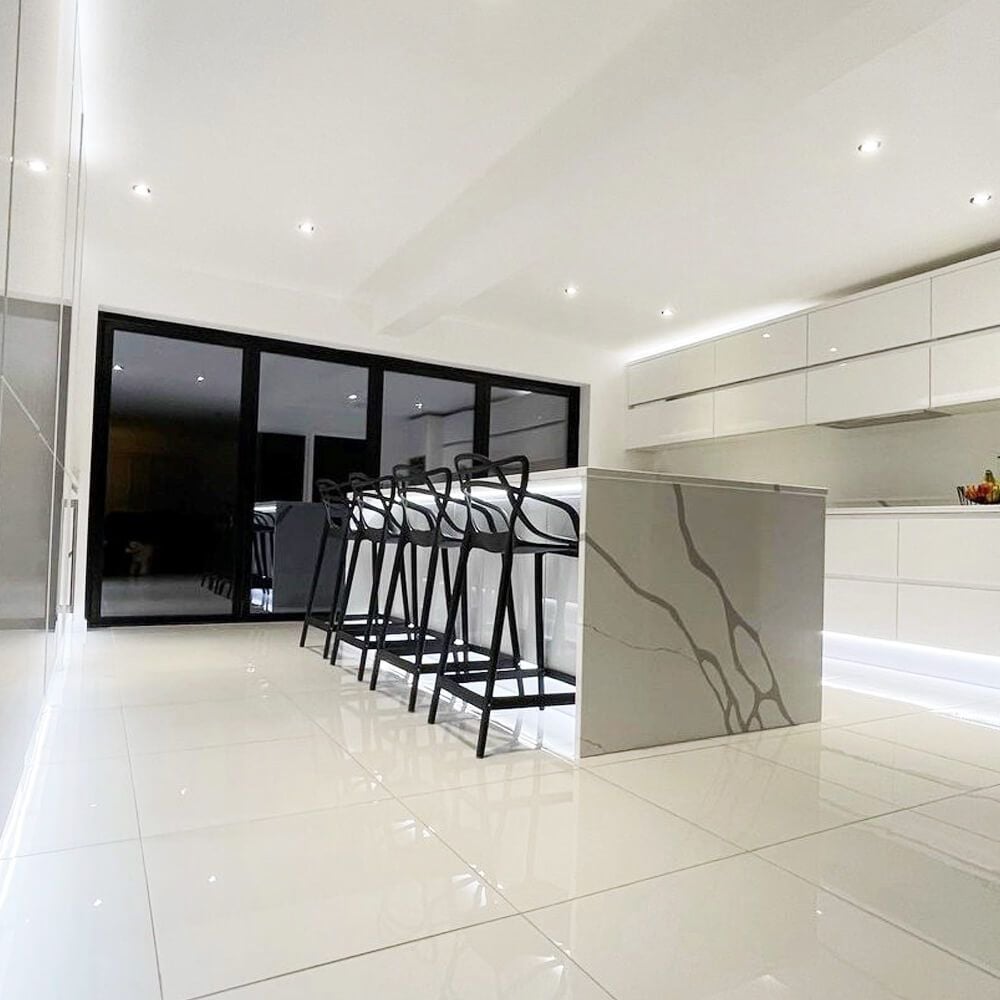
Market Trends: What’s Selling in Australian Kitchens Right Now
2026 Australian kitchen countertop trends favour:
- Large-format thin porcelain slabs (6–12 mm thick, up to 3200×1600 mm). Matte finishes dominate over high-gloss due to fingerprint resistance.
- Marble-look patterns — Calacatta, Statuario, and Carrara white with subtle grey veining. Concrete-look and terrazzo patterns are rising in commercial projects.
- Solid colours — charcoal, slate grey, and warm beige for minimal interiors.
- Slip-resistant finishes (P3/P4) for breakfast bars and outdoor kitchens — a niche outdoor tile crossover.
- Thinner edges — 20 mm edge with 45° bevel or waterfall detail, supported by reinforced substrate.
Importers who stock polished porcelain tiles for matching splashbacks gain cross-sell advantage. The large-format slab category is seeing the fastest growth, with prices stabilising around AUD $45–80/m² retail (landed cost ~$20–30/m² FOB + logistics).
How Factory-Direct Sourcing Changes the Competitive Landscape
Traditional Australian importers buy through local agents or trading companies, adding 15–25% overhead. Direct factory sourcing from Contigo Ceramics eliminates that layer. Benefits include:
- Unbeatable FOB pricing — no middleman markup. Full container pricing includes own‑kiln cost advantage.
- Full customisation — choose gloss level (0–90 GU), rectification edges, bevelling, slip resistance treatment.
- Consistent quality — all slabs undergo ISO 10545 testing in our factory lab. Batch-to-batch color consistency guaranteed within ΔE ≤ 0.5.
- Direct communication — speak directly with our export and production team. No translation delays.
- Low MOQ (1×20ft) — start with a single container of our best-selling kitchen countertop slabs and reorder as demand grows.
This model is already disrupting the Australian market: importers who switched to Contigo Ceramics report 20–30% cost reduction and faster turnaround on specialty orders.
FAQ — Kitchen Countertop Slab Import Australia
1. Do I need to pay anti-dumping duties on porcelain kitchen countertop slabs from China?
Not necessarily. Anti-dumping duties apply to certain ceramic tiles under HS 6907.90.00 and 6907.40.00. However, large-format slabs (≥ 1200 mm in one dimension) with thickness ≥ 6mm and water absorption ≤ 0.5% may be excluded. We recommend using our HS code advisory service (with your order) and engaging a customs broker. Contigo Ceramics provides documentation to support non‑dumped status.
2. What certifications does the Australian Border Force require for porcelain slabs?
Customs typically requests ISO 10545 test results (water absorption, modulus of rupture) and a Certificate of Origin if claiming ChAFTA duty‑free treatment. No separate Australian standards are mandatory for countertops, but many specifiers ask for AS 4459.1 slip resistance if the slab is used for seating or outdoor areas. Our standard test reports satisfy all entry requirements.
3. What is the minimum order quantity for factory‑direct slabs?
We require a minimum of one 20ft container (approximately 1,000 m² of 6 mm slabs; slightly less for 12 mm thickness). This keeps freight cost per square metre low and allows you to test the market with a manageable investment. We also offer mixed loads of different colours/finishes within the same container.
4. How long does it take from order to arrival in Sydney?
Production takes 25–35 days, sea freight from Huangpu to Sydney Port Botony takes 15–20 days, plus 2–3 days for customs clearance. Total lead time is approximately 6–8 weeks from order confirmation. We recommend ordering 2–3 months ahead of your planned launch date.
Get Australia‑specific FOB Pricing
Ready to source high‑quality kitchen countertop slabs with zero duty under ChAFTA? Contact our export team for a personalised FOB quotation tailored to your target Australian port, preferred finish, and volume. We’ll include HS code classification, test reports, and shipping suggestions.