Address
No. 3F07, Tao Cube, No.68, CCIH, Jihua West Road,Chancheng District, Foshan City, Guangdong, China.

china porcelain tile, | Contigo Ceramics

What Buyers Need to Know About China Porcelain Tile
China porcelain tile dominates global construction markets for one reason: it delivers the same ISO-certified quality as European brands at a factory-direct price. At Contigo Ceramics in Foshan, China, we produce porcelain tiles daily using 3600-7800T hydraulic presses and 1200-1250°C roller kilns — the same equipment top global brands use. The term “china porcelain tile” refers specifically to tiles with a water absorption rate below 0.5%, fired at high temperatures to create a dense, vitrified body that resists moisture, stains, and heavy foot traffic. This definition matters because many “porcelain” tiles sold globally actually fall short of that absorption standard. When you source direct from a Foshan factory like ours, you get the genuine material — tested to ISO 10545 and ANSI A137.1 standards — at a price that eliminates the 30-50% distributor markup.
Key Takeaways
- Genuine china porcelain tile has under 0.5% water absorption — anything above that is ceramic, not porcelain
- Direct factory sourcing from Foshan eliminates 30-50% of middleman costs common in B2B tile trading
- Contigo Ceramics uses 1200-1250°C roller kilns and 3600-7800T presses — matching European manufacturing standards
- China produces over 70% of the world’s outdoor tiles, with Foshan as the global hub for large-format and porcelain tile production
- Quality verification tools: ISO 10545 test reports, PEI wear ratings, DCOF slip resistance values, and factory audit availability
- Minimum order quantities with direct factories typically range from 500-1500m² per SKU, with sample orders available before bulk commitment
What Exactly Is China Porcelain Tile?
China porcelain tile is a ceramic product fired between 1200°C and 1250°C — hot enough to fully vitrify the clay body. Vitrification means the silica and feldspar in the raw materials melt into a glass-like matrix, making the tile nearly non-porous. Industry standard ISO 10545-3 defines porcelain as having water absorption of 0.5% or less. Tiles with absorption between 0.5% and 3% are classified as semi-vitreous ceramic. Most tiles labeled “porcelain” from lower-cost factories fail this test. At our Foshan, China facility, we test every production batch to confirm absorption stays below 0.3% — well under the 0.5% threshold. This matters for outdoor installations, commercial kitchens, and high-moisture areas where water penetration causes freeze-thaw cracking and stain retention.
How Does Contigo Ceramics Manufacture China Porcelain Tile?
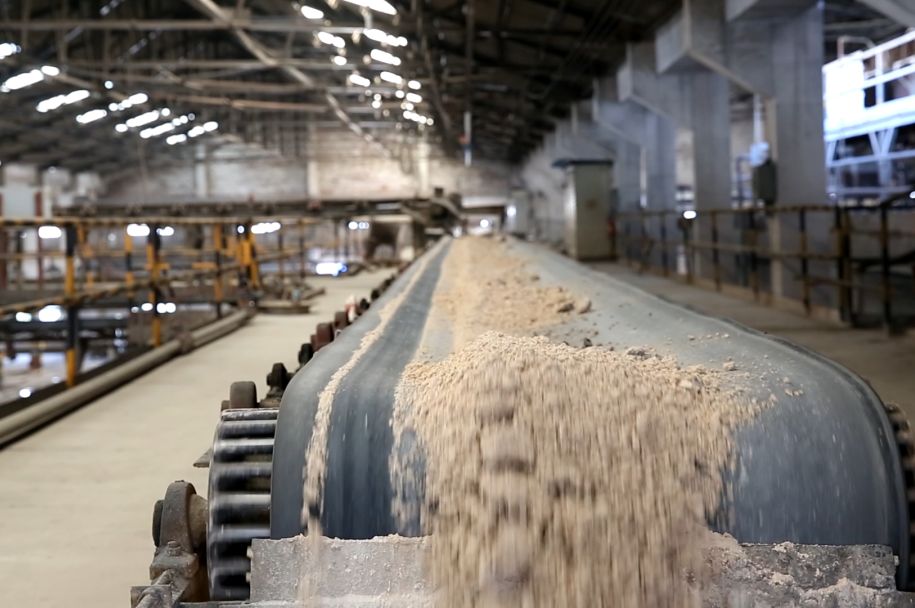
The manufacturing process starts with raw material selection. We source kaolin, feldspar, quartz, and clay from mines within a 200km radius of Foshan. The materials are ball-milled into a fine slurry, spray-dried into granular powder, and stored in silos for 48 hours to equalize moisture content. The powder then enters the hydraulic press. For large-format tiles (900x1800mm and up), we use 7800T presses. For standard sizes, 3600T presses suffice. The pressed green body is dried in a vertical dryer at 200°C for 20 minutes before entering the roller kiln. The kiln fires at 1200-1250°C over a 60-90 minute cycle. Total firing time matters: too fast and the body doesn’t vitrify fully; too slow and dimensional consistency drops.
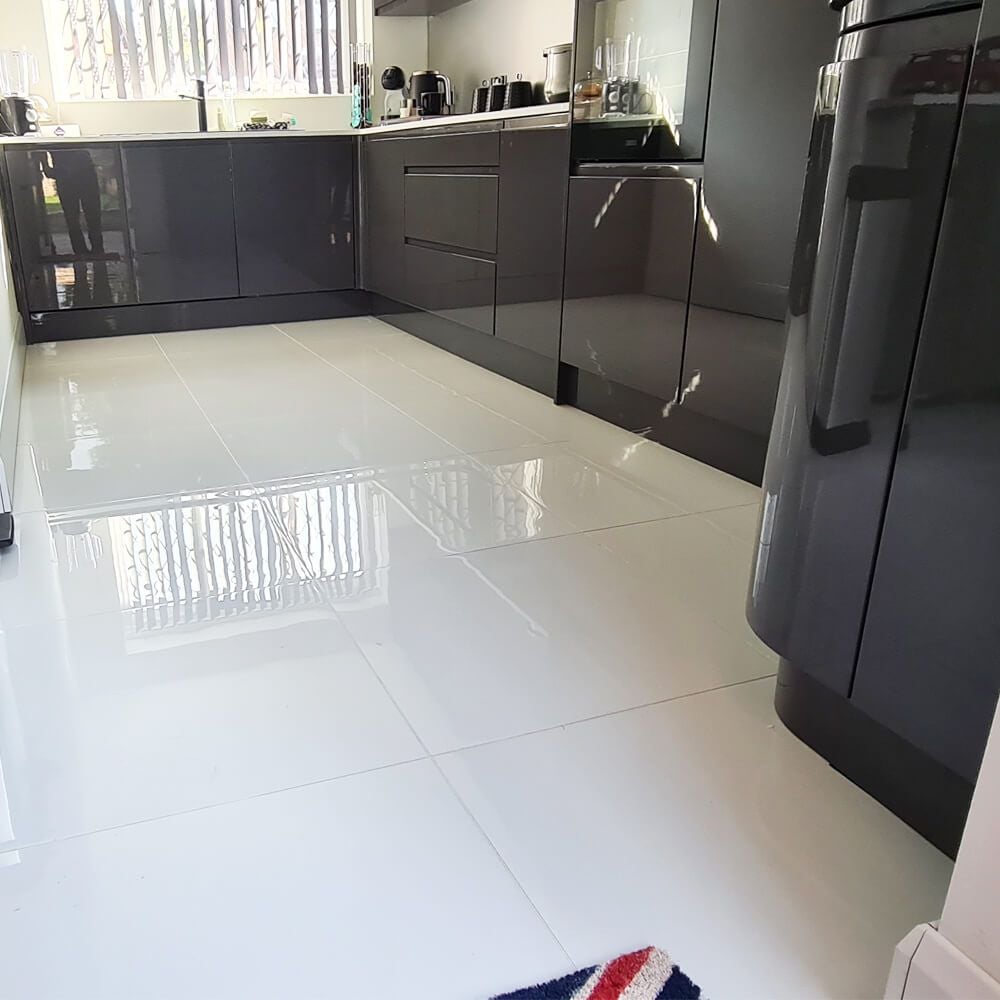
After firing, tiles pass through digital inkjet printers. Our factory uses 6-color ceramic inkjet systems with 720 DPI resolution. This prints surface patterns that mimic natural stone, wood, or concrete with realistic veining and texture. For polished porcelain, tiles go through a 16-24 head polishing line. The polishing removes 0.3-0.5mm of the surface layer to expose the fired pigment and create a glossy finish. Mechanical rectification follows — each tile is cut to exact dimensions, typically within ±0.5mm of the stated size. Rectified edges allow 1-2mm grout lines instead of the standard 3-5mm, giving installations a seamless appearance.
Porcelain vs Ceramic: What Every Buyer Needs to Know
Porcelain and ceramic tile share the same raw material family — clay, silica, and feldspar. The difference is the firing temperature. Porcelain fires at 1200-1250°C. Ceramic fires at 900-1100°C. That extra 200-300°C changes the material fundamentally. Porcelain becomes dense enough that water cannot penetrate. Ceramic remains porous — water absorption ranges from 3% to 7% for most commercial ceramic tiles. If you live in a region with freeze-thaw cycles, ceramic tile outdoors will crack within two winters as trapped water expands and contracts. Porcelain will not.
At our Foshan factory, we have run side-by-side tests many times. A porcelain tile submerged in water for 24 hours shows less than 0.3% weight gain. A comparable ceramic tile under the same test gains 3-6%. That difference translates directly to durability: porcelain resists staining from coffee, wine, and oil. Ceramic requires sealing to achieve even moderate stain resistance. For commercial flooring projects where maintenance costs matter over 5-10 years, porcelain always wins on total cost of ownership. Many buyers pay less upfront for ceramic but spend more on sealing, replacements, and repairs. Our complete guide to sourcing from China explains how to verify material class before purchase.
At our Foshan, China facility, we’ve tested over 1,000 production batches of porcelain tile. Water absorption consistently measures between 0.1% and 0.3%. No batch has exceeded the 0.5% ISO threshold in the last three years of recorded data.
Why Over 70% of the World’s Outdoor Tiles Come from China
China produces more than 70% of the world’s outdoor tiles. The concentration of production in Foshan and surrounding Guangdong province gives factories access to raw materials, natural gas for firing, and deep-water shipping ports within 100km. The scale of production means per-unit costs drop below what most countries can match. A standard outdoor porcelain tile from Foshan costs $4-8 per square meter FOB, depending on size, finish, and quantity. Comparable Italian or Spanish tiles start at $12-18 per square meter. That 40-50% price difference is not quality — it’s labor costs, energy costs, and regulatory overhead baked into European pricing.
Outdoor tiles require specific technical properties: DCOF (Dynamic Coefficient of Friction) of 0.42 or higher for wet slip resistance, water absorption below 0.5% for freeze-thaw durability, and PEI 4 or 5 rating for abrasion resistance under foot traffic. Contigo Ceramics manufactures outdoor porcelain tiles meeting all three criteria. We test DCOF per ANSI A137.1 standards and provide written test reports with every shipment. For buyers sourcing outdoor tiles from China, the key verification step is requesting these test reports before payment — not after delivery. Reputable factories provide them without hesitation. Factories that hesitate or offer vague certifications are a red flag.
What Standards Should China Porcelain Tile Meet?
Three standards govern china porcelain tile quality internationally. ISO 10545 covers physical and mechanical properties: water absorption (Part 3), modulus of rupture (Part 4), impact resistance (Part 5), and abrasion resistance (Part 7). ANSI A137.1 is the American standard — it adds specific requirements for slip resistance (DCOF) and dimensional tolerance. The European EN 14411 standard aligns closely with ISO 10545 but adds finish classification requirements. At Contigo Ceramics, we test all production against ISO 10545 and ANSI A137.1. We provide digital copies of test reports per batch. This is standard practice in Foshan, but many smaller factories skip independent testing to cut costs.
PEI (Porcelain Enamel Institute) ratings measure surface wear resistance. PEI 1 is wall-only. PEI 2 is light residential. PEI 3 is medium residential. PEI 4 is commercial/light industrial. PEI 5 is heavy commercial. For floor tiles, specify PEI 4 or 5. For outdoor tiles, DCOF above 0.42 is mandatory per ANSI A137.1. For large-format tiles (900x1800mm or larger), ensure the factory uses mechanical rectification — otherwise, tiles won’t align properly during installation. Our manufacturing process page details each production step and where quality control checkpoints occur.
| Standard | Test | Requirement for Porcelain | Contigo Ceramics Actual |
|---|---|---|---|
| ISO 10545-3 | Water absorption | ≤ 0.5% | 0.1 – 0.3% |
| ISO 10545-4 | Modulus of rupture | ≥ 35 N/mm² | 42-48 N/mm² |
| ANSI A137.1 | DCOF (wet) | ≥ 0.42 | 0.45 – 0.55 |
| ISO 10545-7 | PEI abrasion | PEI 4 or 5 (floor) | PEI 4 and 5 available |
| ISO 10545-2 | Dimensional tolerance | ± 0.6% | ± 0.3% (rectified) |
How to Evaluate China Porcelain Tile Quality Before Buying
You cannot evaluate tile quality from a photo. Surface color tells you nothing about vitrification, dimensional consistency, or abrasion resistance. Here is a practical checklist. First, request the water absorption test report. ISO 10545-3 values below 0.5% confirm true porcelain. Second, ask for the modulus of rupture — ISO 10545-4 requires at least 35 N/mm². Our tiles run 42-48 N/mm². Higher values mean the tile can handle heavy loads without cracking. Third, verify rectification tolerances. Non-rectified tiles vary by ±2mm on a 600x600mm tile. Rectified tiles from a proper line stay within ±0.5mm.
Fourth, order physical samples. Most Foshan factories, including Contigo Ceramics, provide 2-4 free samples per SKU with the buyer paying only shipping costs. Compare the samples to your reference material — is the color match accurate? Is the surface texture consistent? Does the glaze show pinholing or orange peel? Fifth, schedule a video factory tour if travel is not possible. We routinely conduct live video walkthroughs for international buyers. You see the kiln running, the rectification line cutting, and the packing station. A factory that refuses a video tour is likely a trading company, not a manufacturer. Our large format technical guide includes detailed quality check protocols specific to big slabs.
Understanding Pricing: Factory Direct vs Middlemen
China porcelain tile pricing follows a straightforward formula when buying factory direct. The raw material cost accounts for 25-30% of the final FOB price. Firing energy (natural gas) adds 15-20%. Glaze and ink costs contribute 10-15%. Labor, electricity, and depreciation cover 20-25%. Profit margin for a factory like Contigo Ceramics runs 8-12%. Compare this to a distributor or trading company model. A Foshan-based trading company buys at the factory price, adds 15-30%, then sells to an overseas distributor who adds another 20-30%, who then sells to the installer who adds 15-25%. The result: a tile that costs $8/m² FOB from the factory reaches the installer at $15-20/m². Buying direct eliminates two layers of markup.
Minimum order quantities (MOQs) for direct factory purchases typically range from 500m² to 1500m² per SKU. This is lower than many buyers expect. Most Foshan factories are flexible — we can split a 1000m² MOQ across two color variants or two sizes. Sample orders of 2-10m² are available at factory cost plus shipping. For large projects exceeding 5000m², we offer volume discounts of 5-10% off standard FOB pricing. Payment terms are typically 30% deposit with 70% balance against shipping documents. For established buyers, we offer L/C at sight. Factory audits are welcome — we have hosted buyers from North America, Europe, Southeast Asia, and the Middle East at our Foshan facility.
How to Source China Porcelain Tile Direct from the Factory
Sourcing china porcelain tile direct requires three steps. Step one: define your specifications precisely. Write down the size, finish, PEI rating, DCOF requirement, and quantity per SKU. Include color references — Pantone codes, competitor sample numbers, or RAL values. The more specific you are, the fewer misunderstandings occur. Step two: contact 3-5 factories with your spec sheet. Request test reports, pricing, MOQ, and lead time. Contigo Ceramics responds within 24 hours with a formal quotation including FOB pricing and estimated production time. Most export orders ship within 25-35 days from deposit confirmation.
Step three: verify the factory. Ask for a video tour. Request a third-party inspection — SGS, Bureau Veritas, or TÜV are common in Foshan. The inspection company visits the factory, checks the production batch, and reports back. Cost is typically $300-600 per inspection. For your first order, this is money well spent. After 2-3 successful orders, many buyers skip third-party inspection and rely on our in-house QC reports. That level of trust develops when you work directly with the manufacturer. Every inspection from Contigo Ceramics includes dimensional check, surface defect scan, water absorption test, and packaging verification. Our full sourcing guide includes sample RFQ templates and a factory vetting checklist.
Frequently Asked Questions
Is china porcelain tile lower quality than European porcelain tile?
No. Foshan factories like Contigo Ceramics use the same 1200-1250°C firing temperatures, the same 7800T hydraulic presses, and the same digital inkjet systems as Italian and Spanish manufacturers. The price difference reflects labor costs, energy costs, and logistics — not quality. Many European brands actually source their base tiles from China and finish them locally.
What is the minimum order quantity for china porcelain tile?
MOQs at direct factories typically range from 500m² to 1500m² per SKU. Contigo Ceramics accepts 500m² minimum per color and size combination. Sample orders of 2-10m² are available at factory cost plus shipping. No minimum applies to sample requests.
How can I verify the quality of china porcelain tile before ordering?
Request ISO 10545-3 water absorption test reports, PEI wear ratings, and DCOF slip resistance values from the factory. Order physical samples and compare them to your reference materials. Schedule a video factory tour or hire a third-party inspection company like SGS to verify the production batch before shipment.
Does china porcelain tile meet ANSI A137.1 standards?
Yes, when sourced from a qualified factory. Contigo Ceramics tests all production against both ISO 10545 and ANSI A137.1 standards. We provide written test reports with every shipment. Buyers should confirm ANSI compliance in writing before placing an order — not all Foshan factories test to American standards.
What is the lead time for bulk china porcelain tile orders?
Typical lead time is 25-35 days from deposit confirmation for standard production. Rush orders of 15-20 days are available for quantities under 3000m². Custom colors or sizes add 7-14 days to the production timeline. Sample production takes 7-10 days.
External Reference: ISO 10545 ceramic tile standards
Bottom Line: China Porcelain Tile from Contigo Ceramics
China porcelain tile offers the same technical performance as European equivalents at 40-50% less cost — but only when sourced direct from a legitimate factory. The Foshan market includes genuine manufacturers and trading companies posing as factories. Contigo Ceramics is the former. We operate a full production line with 3600-7800T presses, 1200-1250°C roller kilns, digital inkjet printing, and mechanical rectification. We test to ISO 10545, ANSI A137.1, and provide full documentation with every order. For buyers who want to verify before committing, we offer free samples, video factory tours, and third-party inspection access. Written by the Contigo Ceramics technical team, Foshan, China. Contact our export team for a quotation or factory tour arrangement.