Address
No. 3F07, Tao Cube, No.68, CCIH, Jihua West Road,Chancheng District, Foshan City, Guangdong, China.

ceramic tiles in china | Contigo Ceramics

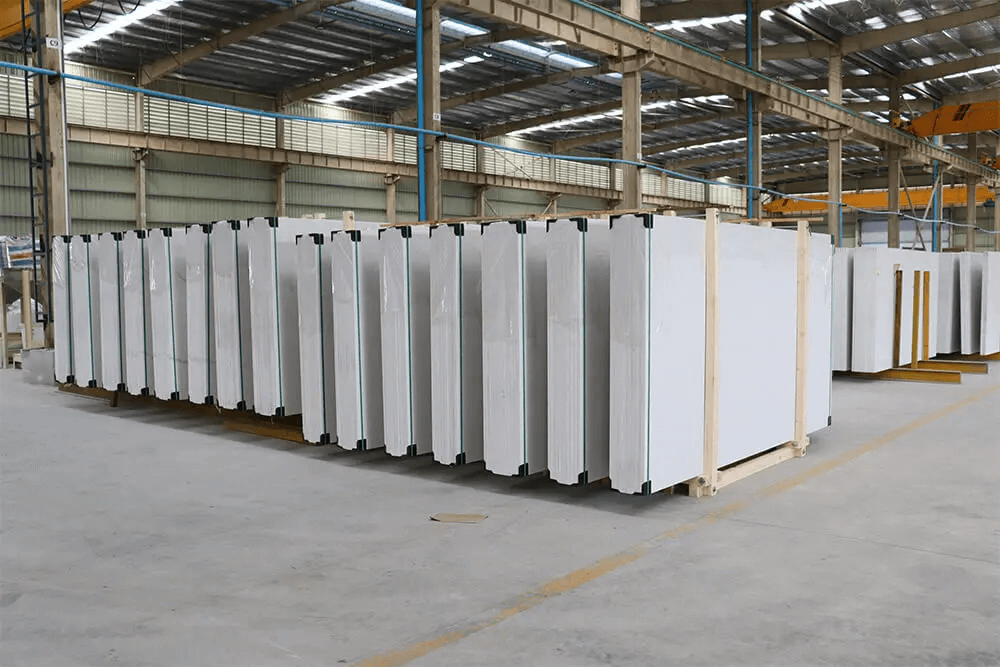
If you’re sourcing ceramic tiles in China, you already know the price advantage is real. What you might not know is how to separate a qualified factory from a trading company charging 30% markup on someone else’s production. At Contigo Ceramics, we operate a 1200–1250°C roller kiln in Foshan with 3600–7800T hydraulic presses and full digital inkjet lines. We sell directly to international buyers with no middleman. This guide covers everything you need to evaluate a supplier – from manufacturing specs to real factory-gate pricing. You’ll learn exactly what quality standards like ISO 10545 and ANSI A137.1 mean for your project, and how to verify them before placing an order.
Key Takeaways
- Ceramic tiles in China are priced from $2.50 to $12.00 per m² FOB at the Foshan port – trading companies add 20–40% markup.
- Only factories with hydraulic presses above 3600T and roller kilns over 1200°C produce tiles that meet ISO 10545 wear and water absorption standards.
- Mechanical rectification is non-negotiable for large format tiles – without it, you’ll get 2mm+ size variation between pieces.
- DCOF ≥ 0.42 is required for commercial wet areas. Chinese factories can test to ANSI A137.1 on request.
- Factory audits are the single best way to verify real production capacity. We welcome visits to our Foshan facility.
- Minimum order quantities typically range from 500 m² to 2000 m² per SKU for direct factory pricing. Lower MOQ is available through stock lots.
Ceramic tiles in China refer to clay-based tiles fired at temperatures between 1150°C and 1250°C in industrial roller kilns, primarily produced in the Foshan region of Guangdong province. These tiles are made from a mixture of clays, feldspar, and silica that is pressed under hydraulic force (typically 3600–7800 tons for large formats), dried, glazed with digital inkjet printers, and fired to achieve hardness ratings of PEI 3–5. Water absorption rates vary: porcelain tiles (the most common export grade) absorb less than 0.5% by weight per ISO 10545-3, while standard ceramic tiles can absorb up to 3%. The term “ceramic tiles” in China often includes both ceramic and porcelain categories, though international standards distinguish them. The main advantage of sourcing directly from a Chinese factory is price – no distributor margin – combined with production scale that allows custom colors, sizes, and finishes on orders as small as a single container.
Why Foshan dominates ceramic tiles in China
Guangdong province, and specifically Foshan, accounts for over 60% of China’s ceramic tile output. The city runs more than 1000 production lines, supported by a deep supply chain of glaze chemists, ink manufacturers, and mold makers. This concentration means raw material costs are lower, logistics to the port of Guangzhou take three hours, and experienced labor is abundant. At our facility in Foshan, we source clays from Guangdong and Fujian, fire with natural gas (not coal), and recycle 95% of our process water. For a buyer, this translates to consistent quality – you’re not buying from a single kiln in a remote province. You’re buying from an industrial cluster that has been exporting tiles for over twenty years.
How much do ceramic tiles in China really cost?
This is the most asked question we get, and the answer is frustratingly vague on most websites. So let’s be specific. At Contigo Ceramics, FOB Guangzhou prices for standard glazed porcelain tiles (600×600mm, PEI 4) range from $3.20 to $5.80 per square meter. For large format rectified tiles (900×1800mm) with digital inkjet decoration, expect $7.50 to $12.00 per square meter. Matte outdoor tiles with DCOF ≥ 0.42 run $4.50 to $7.20 per square meter. These are factory-direct prices – no agent, no brand markup. Compare that to a trading company that sources from three different factories and adds 20–40% margin. A typical importer buying from a trading company pays $8–$14 per m² for the same tile we sell at $5.
| Tile Type | Size | PEI | FOB Price (USD/m²) | Typical Trading Company Price |
|---|---|---|---|---|
| Glazed porcelain – polished | 800×800mm | 4 | $4.20 – $6.50 | $7.00 – $10.00 |
| Matte outdoor (DCOF ≥ 0.42) | 600×600mm | 5 | $4.50 – $7.20 | $7.50 – $11.00 |
| Large format rectified | 900×1800mm | 4 | $7.50 – $12.00 | $12.00 – $18.00 |
| Full-body porcelain | 600×1200mm | 5 | $6.00 – $9.00 | $10.00 – $14.50 |
Manufacturing process: what factory direct really means
Seeing a factory running is the best way to understand why price differences exist. At our facility, the process starts with ball milling raw materials to a specific particle size. The spray-dried powder then goes into a hydraulic press – we use 3600T for standard formats and 7800T for 900×1800mm and larger. Pressing force directly affects tile density and edge sharpness. Next, the green body enters a vertical dryer, then gets glazed and decorated by a digital inkjet printer capable of 1200 dpi resolution. After glazing, the tile is fired for 50–70 minutes in a roller kiln reaching 1220°C. Finally, if rectified, the tile passes through a mechanical rectification line that cuts edges to exact dimensions (now within ±0.3mm). A high-speed polishing line with 16–24 heads then creates the final surface finish.
Our factory operates two production shifts, running 24 hours a day during peak seasons. Every batch is tested in-house for water absorption (ISO 10545-3), modulus of rupture (ISO 10545-4), and surface hardness (PEI per ASTM C1027). We also perform thermal shock tests (ISO 10545-9) and stain resistance (ISO 10545-14). These tests are not theoretical – we log results per firing. Buyers visiting our Foshan facility can view the test records and even take samples from the current production run.
Quality standards for ceramic tiles in China
Not all Chinese tiles are created equal. The difference comes down to which standard the factory commits to. For export, the most common standard is ISO 10545 series, covering absorption, breaking strength, thermal shock, and abrasion. Many Chinese factories also quote ANSI A137.1 for U.S. projects. At Contigo Ceramics, we produce to both, depending on your destination market. For commercial floors, we recommend PEI 4 or 5 – meaning the glaze can withstand heavy foot traffic without showing wear. For outdoor applications, we test to DCOF (Dynamic Coefficient of Friction) per ANSI A137.1-2019. A DCOF value of 0.42 or higher is required for wet commercial areas; we routinely achieve 0.44–0.50 on our matte outdoor tiles.
“In 2023, we produced over 3.2 million square meters of ceramic tiles. Our internal defect rate is 0.8%. Every tile we export meets ISO 10545 surface flatness Class 1 (maximum deviation 0.5% of diagonal length).” — Contigo Ceramics Quality Report 2023

How to buy ceramic tiles in China without getting burned
You have three sourcing paths: a trading company (risk: price markup, quality unknown), an online B2B platform (risk: end seller often not a factory), or a direct factory relationship. Contigo Ceramics sells direct. Here is how to verify any factory – and we welcome this scrutiny ourselves. First, ask for the company’s business license and check the “business scope” – it must list “ceramic tile manufacturing” specifically. Second, request a factory tour video showing the kiln, press, and packing line. Third, ask for test reports from a third-party lab like SGS or Intertek for the specific tile you want. Fourth, confirm MOQ – we work with 500 m² per SKU for standard sizes, 1000 m² for large formats. Finally, always get the FOB price in writing and confirm it includes export packing (wooden crates with steel straps for sea freight).
Large format and outdoor tiles: the factory advantage
Large format tiles (900×1800mm and 1200×2400mm) require heavy presses and accurate kiln temperature control. Not all Chinese factories have 7800T presses. At Contigo Ceramics, we do – and that press is what makes big tiles flat and consistent. Similarly, outdoor tiles must be frost resistant and have low water absorption. Our full-body porcelain outdoor line absorbs less than 0.3% water and passes 25 freeze-thaw cycles per ISO 10545-12 without surface damage. If you’re importing for a commercial plaza, hotel pool deck, or rooftop terrace, you need these specifications documented. We provide them.
Why middlemen exist – and how to bypass them
Trading companies thrive on buyer ignorance. They know that most first-time importers don’t know the difference between a 3600T and 7800T press, or that rectified tiles require mechanical calibration. They take a 20–40% cut and offer nothing in manufacturing value. You can bypass them by sourcing directly from a factory that sells under its own brand but also does OEM. Contigo Ceramics offers both: you can buy our Contigo brand for stock products, or we do OEM with your own box, logo, and specifications. Minimum for OEM is 500 m² per SKU with 2000 m² total order. We handle export documentation, fumigation, and container loading.
Frequently Asked Questions
Are all ceramic tiles in China the same quality?
No. Quality varies significantly based on press tonnage, firing temperature, raw material purity, and quality control. Factories using 3600T+ presses and 1200°C+ kilns produce tiles that meet international standards. Smaller workshops may use cheaper glazes or lower firing temperatures, resulting in higher water absorption and less wear resistance. Always ask for third-party test reports.
What is the minimum order quantity for ceramic tiles in China?
At Contigo Ceramics, MOQ is 500 m² per SKU for standard 600×600mm or 800×800mm sizes. For large format (900×1800mm), MOQ is 1000 m². Stock lots and closeout colors may allow lower MOQ – contact us to check current inventory.
How long does shipping take from China to the USA or Europe?
Production takes 3–4 weeks from order confirmation. Ocean freight from Guangzhou to Los Angeles is about 18–22 days, to Rotterdam around 28–32 days. Total lead time including customs clearance is typically 6–8 weeks from payment.
Can I visit the factory and see production?
Yes. We welcome buyer visits to our Foshan facility. We show you the entire production line – raw material batching, pressing, drying, printing, firing, polishing, and packing. You can take samples from the kiln exit and run your own tests. Contact us to schedule a visit.
Do you provide free samples of ceramic tiles?
We provide up to 5 free sample pieces (300×300mm) per product. You pay shipping. For larger evaluation samples (full tile), we charge cost plus shipping, refundable on first order.
Conclusion: Buy ceramic tiles in China factory direct
Sourcing ceramic tiles in China doesn’t have to be a gamble. When you work directly with a manufacturer like Contigo Ceramics, you get real pricing, verified quality standards, and a transparent production process. You can visit our Foshan factory, inspect our test reports, and order with confidence. We produce tiles that meet ISO 10545, ANSI A137.1, and DCOF slip resistance requirements for commercial projects worldwide. If you’re ready to bypass the middleman and get factory-direct pricing, contact Contigo Ceramics for a quote on your next project. We’ll send you our current stock list and FOB price sheet within 24 hours. Written by the Contigo Ceramics technical team, Foshan, China.